
Hand Analysis, as taught and promoted by the International Institute of Hand Analysis (IIHA), was born out of the encounter between the ancient art of palmistry and the scientific study of fingerprints. Developed in the 1970’s by Richard Unger, it is not predictive and has been empirically supported by more than 150’000 analyses.
A full model of human behavior
The originality of Hand Analysis lies in the combination of information from our personality and our soul.
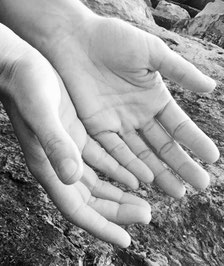
The different aspects of our personality are written in the lines and shape of our hands. Their interpretation allows us to essentially discover our temperament, our thinking and emotional style, and our particular skills. Our personality can evolve and change over time, as do the lines on our palms.
The information regarding our soul lies at our fingertips, in those unique, unchangeable and unalterable patterns: our fingerprints. There, five months before we were born, our life agenda has been engraved. It addresses the following questions: what is my reason for being, my life purpose? What did I come to learn in this lifetime? What kind of challenges do I need to work on to live a meaningful and fulfilling life? Our life agenda shows us the way to become who we really are: find our deep and true nature, reconnect with it and develop our life from it.
By combining these two kinds of information, we can have a perspective on our current situation, in relation to the big picture of our life story: comparing who and where we are now with who we are meant to be and what we are meant to do in this lifetime. This perspective allows us to make new choices and start moving towards the fulfillment of our life purpose.
From palmistry to the scientific study of fingerprints
Richard Unger first learned about palmistry, the art of interpreting the lines and signs written on the palm of the hand to understand the different components of human personality and foretell the future. It has been practiced in China and India for more than 5'000 years, and appeared in the Occident approximately 300 years BC. In Europe, it began to expand in the Late Middle Ages, thus gaining authority to the point of being taught in some universities in the 16th century.
For more than 10 years, Unger focused entirely on studying hands. Willing to modernize this ancient art and to develop a coherent system of rules reflecting as faithfully as possible the human personality, he tested systematically the information of all the palmistry literature available in English, discarding all the incorrect and predictive interpretations, keeping only the coherent and verifiable ones.
Insatiable and convinced that our hands held a full and accurate model of human behavior, he continues his reading and research in medical libraries, immersing himself in the world of dermatoglyphics.
The discovery of Dr. H. Cummins, stating that fingerprints begin to appear on fetal fingertips as early as the 14th week of gestation, forming a topographic-like map, was a turning point in Unger's researches. What if those unique, unchangeable and unalterable patterns, whose formation and utility is still not fully understood, would hold our life agenda?
Following his firm belief, that like sand dune or the sandy ocean floor, built by the energy of wind and water, our fingerprints are a soul-level imprint, Unger developed the LifePrints© system in 1979. This innovative tool, able to decipher the life agenda engraved in our fingertips, reveals the coded picture of our highest potential. Combined with the system of information related to our personality, this forms the foundation of IIHA Hand Analysis.
For more information: www.handanalysis.net (IIHA website).

“The Great Spirit breathes in the breath of life
and the tracks of that breath become our fingerprints.”
Navajo saying